“Is there any point to which you would wish to draw my attention?”
“To the curious incident of the dog in the night-time.”
“The dog did nothing in the night-time.”
“That was the curious incident.”
(Conan Doyle, Silver Blaze)
Talking Points
- Energy prices have fallen hard, but the reasons are temporary and seasonal, not structural
- For Europe, and Britain in particular, cheaper crude in July does not mean cheap energy in December, unfortunately
- We expect this to reassert itself through bond yields and probably the currency—but not in earnest until late Q3 and into Q4, when the heating goes back on
- The SpaceX float looks to us like a textbook late-cycle top, and the supply mechanics get worse from here
- Starmer, as Helen predicted last quarter, has not survived. That is her territory—but for us it keeps UK assets cheap and under pressure
Last quarter, we told you the energy dog was about to bark loudly, and that Britain was one of the closest countries to the doghouse. Three months on, the dog has said nothing. Brent has drifted down to around $72, roughly 22% lower over the month and near its weakest since February. A reader glancing only at the screen would conclude the crisis is over.
Holmes’s insight was that silence is itself evidence. So it is worth being precise about why the dog is quiet, because the explanation is not “the problem has gone away.”
Enjoy the Silence (Depeche Mode, 1990)
The prompt price has fallen due to a run of temporary reasons. Tanker traffic through Hormuz has been recovering; OPEC+ has waved through another quota increase, and Gulf exports are running back toward pre-war levels; Saudi Aramco has cut its Asian selling price to a discount it last offered during the price wars of 2015 and 2020; and the market has convinced itself that the US–Iran talks will hold and that it is back to business as usual. In other words, the spot market is pricing a ceasefire and a mild autumn.
We would not.
None of this repairs the structural position, and the structural position is what matters for you as sterling-based investors. Britain remains unusually dependent on gas-fired power, domestic production continues to decline, and the country now imports its vulnerability. A cheaper barrel in July, delivered into a market that is de-stocking and enjoying summer demand, tells you very little about what the gas bill looks like when the temperature drops. The calm is seasonal and geopolitical. It is not foundational, and it is not paid for.
Tanker Traffic Remains at a Fraction of Its Previous Levels
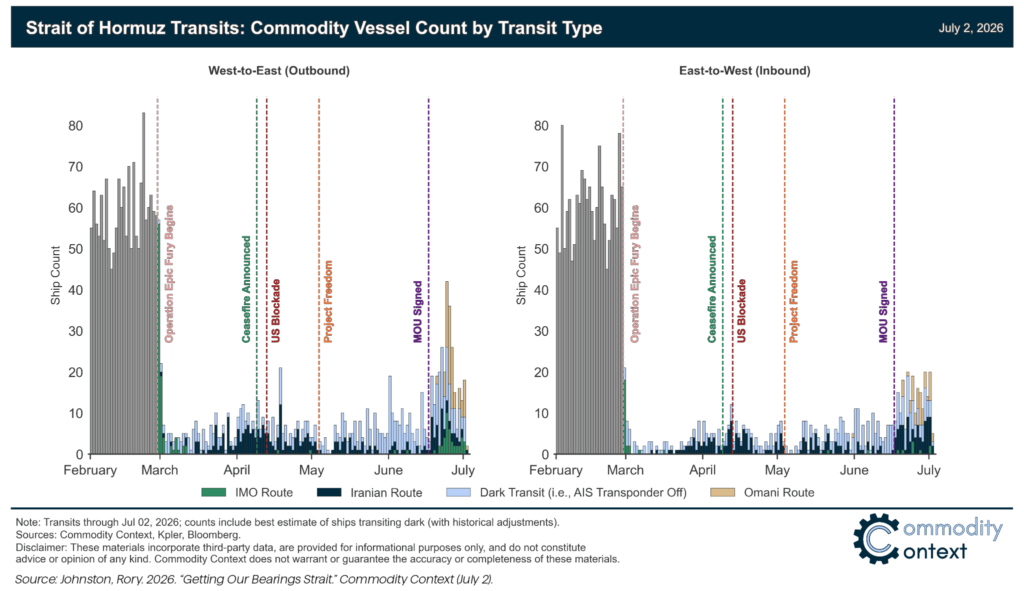
The transmission from here is the same one we sketched last time, only deferred. Sticky energy-led inflation leaves the Bank of England trapped, unable to cut meaningfully into a weakening economy without letting expectations drift—which keeps gilt yields sensitive at exactly the moment the fiscal accounts can least tolerate it, and that pressure eventually reaches the currency. The reason none of this is screaming yet is simply the calendar. We think the bill arrives late in the third quarter and into the fourth, when we start heating houses again, and the market discovers that the truce and the thermostat are not as accommodating as hoped.
European Gas Prices Have Remained Elevated, and It’s Not Yet Winter
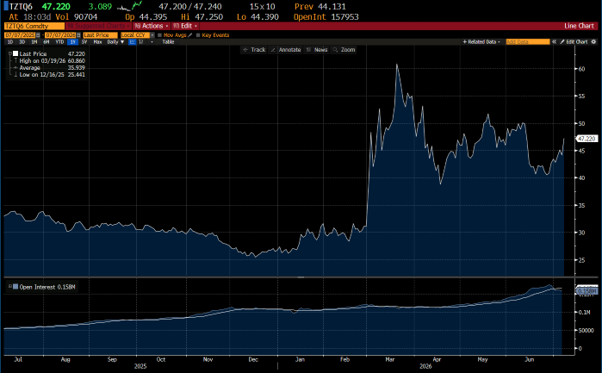
Source: Bloomberg, July 7, 2026.
Space Oddity (David Bowie, 1969)
If energy is the quiet risk, the SpaceX flotation is the noisy one—and to us it has the unmistakable smell of a top.
The company came to market at $135, spiked toward $225 on the first days of trading, and briefly carried a valuation north of $2.6 trillion before settling around $2 trillion. That melt-up was not a verdict on value; less than 5% of the stock was actually free to trade. It was scarcity, dressed up as conviction. Meanwhile the underlying business is consuming cash prodigiously, funding capex several times its operating cash flow with a widening gap plugged by debt and fresh equity.
Two things are worth holding in mind. First, at $75 billion this was the largest IPO in history, and that money had to come from somewhere. As we discuss later, it looks to us as though a good deal of it was funded by trimming other large US technology names—a rotation within the complex rather than fresh capital arriving—which is precisely why a single deal can weigh on the whole sector.
Second, and more mechanically: the supply picture only worsens from here. The lock-up is not a single cliff but a staggered release—a first tranche of insider stock frees up around the Q2 results, followed by further time-based releases through the autumn and a larger slug after the Q3 numbers, before the full expiry in early December. By the time I write to you next, a very large quantity of previously restricted stock will have become eligible to sell into a market whose entire float is currently tiny. (Mr Musk’s own holding, mercifully for the tape, stays locked into the middle of 2027—that overhang is a story for another day.) Scarcity on the way up; a flood on the way down. That is what late-cycle enthusiasm tends to look like just before gravity is reintroduced.
Fool’s Gold (The Stone Roses, 1989)
On politics I will be brief, because it is Helen’s beat and she called it squarely last quarter: Starmer has not survived, and Andy Burnham looks set to walk in, in all probability by coronation rather than contest, on a distinctly more interventionist, left-of-centre prospectus. I will leave the anatomy of that to her section.
For us, the investment translation is simple and unlovely. A new leader arriving by internal succession has no fresh national mandate for radical change, and—on the evidence of execution so far—little apparent capacity to deliver one even if he wanted it. Radical change in the other, more expansionary direction is exactly what picks a fight with the bond market. Either way, we struggle to see how this improves sentiment toward UK assets. They remain genuinely cheap. But cheap without a catalyst is not a bargain; it is a value trap, and we expect UK assets to stay cheap and under pressure for the foreseeable future.
We honestly hope it works out for him, given the country’s needs. He has two key advantages Starmer lacked. The first is an understanding of the Labour Party and how it works, so he ‘might’ be able to get more done versus Starmer. Plus, he appears to have some personality, unlike Starmer’s, which even the John Major School of Charisma and Charm would have refused entry for low grades.
However, we are old enough to remember when his nickname was ‘Bodybags’ due to problems with his time in the Health Ministry. Plus, there are the various previous failed campaigns to become leader, and the fact that running the UK is going to be a lot more difficult than coordinating the Manchester bus timetables. Snark aside, we remain open-minded.
A Word on Sterling
One nuance worth flagging, and it cuts against the obvious trade. Sterling has clearly underperformed since the Gulf conflict began. But the CFTC positioning data now show that speculative accounts are holding an increasingly crowded net short position in the pound. Crowded shorts are combustible: they are prone to sharp, violent reversals on very little news—and we have already had a taste of it, with the currency snapping back off its late-June lows. Our medium-term view on sterling remains cautious. It’s a stagnant economy, going nowhere and heading for a likely energy shock. But in the near term, we would be wary of chasing it lower here; the pain trade is a squeeze higher, not a slide.
None of this changes the destination, only the timing. The silence is not the all-clear—it is the interval. We have used it as one should use an interval: to be positioned before the second act, and to draw up the list of things we want to own when the repricing finally arrives.
Changing of the Guard (Bob Dylan, 1978)
A word on how we are positioned, because it follows from everything above: we have spent recent months quietly taking risk down, not up. This is not gloom for its own sake, but a response to what the tape is telling us beneath the headline.
On the surface, all is well. The S&P returned around 9% in the first half; the Dow’s best first half since 2021, with small caps enjoying their strongest run since 1991. The index looks robust. But an index is an average, and averages conceal. This advance has been achieved without the mega-cap generals that led the market for three years: the Magnificent Seven as a group are actually down year-to-date, even as the index has climbed. The market has been carried instead by everything that was previously ignored—the equal-weight index, small caps, energy (the strongest sector of the half, for reasons our first section makes plain), and the semiconductor “picks and shovels.” Leadership has not so much strengthened as changed hands entirely.
And beneath the calm, the former darlings—the names most exposed to the AI-capex bill—have been taken to the woodshed. Purely in terms of how far each now sits below its own 52-week high:
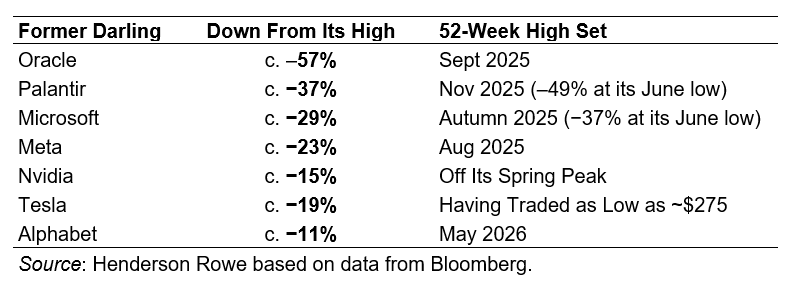
The point is not that these are bad businesses—Oracle carries a $638bn backlog, Microsoft grew Azure 40%—but that even flawless operational delivery has not protected the shares once the market began to ask who actually funds all this capex, and when. Oracle’s free cash flow ran to minus $24bn last year; Amazon came to market this week for another $25bn in bonds. That is precisely the crowding-out we flagged around SpaceX, now visible in the share prices.
So what has worked? The money has not left the AI trade—it has moved down the stack, out of the hyperscalers spending the money and into the suppliers taking it. The half’s biggest large-cap winners were memory and silicon: SanDisk (up a barely credible ~850% year-to-date and the single best stock in the S&P), Micron (up ~300%), Intel (up ~280%), alongside Broadcom and Corning. Of the old guard, only Alphabet (which has roughly doubled over the past year, though as I note above its started to slip) and Amazon have kept their footing at the front.
Two readings of this are possible, and we owe you both. The benign one is a healthy broadening—the market standing on more legs than a handful of tech names, which bulls consider sturdier. The one we lean toward is less comforting: that this is not the end of AI mania but its migration into a new, narrower cohort of red-hot memory stocks, while violent leadership churn plays out beneath a deceptively placid index. Rotation of this ferocity is usually a late-cycle tell, not an early one. We mentioned last year we saw a change coming. We would rather forgo a little upside here than be fully exposed when the market runs out of fresh laggards to rotate into.
More positively, the huge borrowing by US tech has started to edge out other borrowers, and after many months of patience we are starting to see value in selected credit bonds again.
We have also been justified in selling virtually our entire gold holdings, as Keynes’s “barbarous relic” once again demonstrated its lack of civility. We expect to re-enter at some point, but in the meantime, we suspect a further washout is coming.
Gold and Related Shares Peaked Just Before the Start of Hostilities
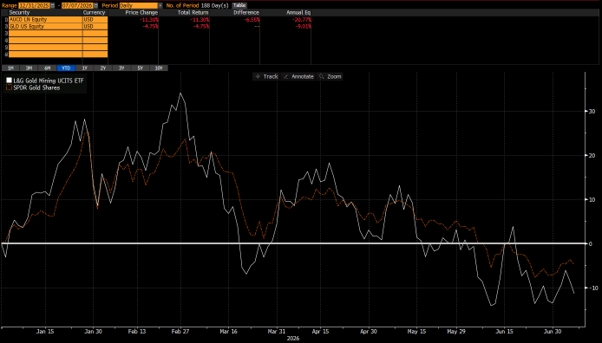
Source: Bloomberg, July 7, 2026.
What Does That Mean?
We suspect we will see many mysteries resolved over the next 6 months: the true direction of energy, whether the US equity market can sustain a set of megacap (and money-losing) IPOs, and whether inflation starts to broaden. Whatever happens, we remain vigilant and will watch for clues.
More soon. And with that, over to Helen.
— Ben Ashby
Note: Market data as of July 7, 2026.

The Burnham Identity
Every political era has its franchise. The Blair years had The West Wing optimism that politics could change the world. The Brexit years became Game of Thrones, with shifting alliances, unexpected betrayals and the occasional decapitation. Rishi Sunak’s premiership often resembled The Office with uncomfortable cringe moments as everyone knew the joke had gone on too long. Now we have The Burnham Identity.
A new protagonist suddenly finds himself thrust into the centre of events. He possesses remarkable political instincts but is haunted by his own past. Every ally might become an enemy. Every institution is suspicious. Every move is watched. There is barely time to catch his breath before another crisis erupts. And, like Jason Bourne himself, there is one lingering question that never quite disappears.
Who exactly is Andy Burnham?
It is a question that has followed him for the best part of three decades. Labour veterans have long enjoyed a joke at his expense: a Blairite, a Brownite and a Corbynite walk into a bar. The barman looks up and asks, “What are you having, Andy?”
Like all enduring political jokes, it contains enough truth to survive.
Burnham has, at various points in his career, been comfortable alongside almost every faction of the Labour Party. He served under Tony Blair and Gordon Brown. He remained loyal through the Miliband years. He avoided becoming defined entirely by either Corbynism or Starmerism. He left Westminster for Manchester and, in doing so, built an identity that transcended Westminster altogether. His critics call this opportunism whilst his supporters call it adaptability.
History suggests the latter is often a prerequisite for successful leadership.
Donald Trump was once a Democratic donor and New York property developer before reinventing himself as the standard-bearer of Republican populism. Emmanuel Macron escaped the collapse of France’s traditional parties by creating one of his own. Boris Johnson, despite impeccable establishment credentials and a Brussels education, rode anti-establishment Euroscepticism to the largest Conservative majority in decades.
Successful leaders are often political chameleons. They assemble coalitions that should not naturally coexist. Burnham is attempting the same trick.
Yet there would be one crucial difference. Trump, Macron and Johnson all secured direct electoral mandates in their own name. Burnham would inherit one.
That distinction matters.
Labour’s parliamentary majority was built under another leader, another manifesto and another political settlement. It was so broad that fractures appeared almost as soon as victory had been secured. The centripetal force that accompanies winning has weakened. Personal loyalties have shifted. Old grievances have accumulated.
From the first day of any Burnham premiership, they will be coming for him.
And it isn’t simply the usual ideological suspects. There will be MPs whose careers were tied to the previous leadership. Ministers who suddenly find themselves unemployed and advisers whose influence evaporated overnight. Nearly a fifth of Labour MPs currently hold ministerial office so the Burnham reshuffle will inevitably create a long list of disappointed former ministers. More significantly, with almost half the parliamentary term having passed, many of them may never get back to their past career highs. Politicians rarely forgive such brutal redundancy.
This means that Burnham may never be stronger than he is before he enters Number 10.
His political strength has always rested on momentum rather than office.
Supporters point to his electoral record in Greater Manchester and his ability to connect with voters who had drifted away from Westminster politics. He is likely to get a further immediate electoral boost when his former Mancunian colleague, Bev Craig, the current leader of Manchester City Council, wins the Greater Manchester Mayoralty on Thursday 30th July.
Momentum is intoxicating but governing is something else entirely.
Team Burnham had thought they might get until after party conference at the end of September to present their platform. Instead we are set for the immediate high-octane pace of Jason Bourne, where various ideas are thrown into the air in something of a state of confusion as we all try to figure out what’s going on.
One priority that is however immediately clear is the commitment to adjusting the balance of power to the regions of the country. For years Burnham has argued that Britain’s excessive centralisation is not merely inefficient but economically damaging. Devolution is not an optional constitutional hobby; it sits at the heart of what he has sometimes described as “Manchesterism”.
It is also a canny political strategy. Manchester is where Burnham built his reputation. It is where he became associated with practical government rather than Westminster theatre. More importantly, it taps into the defining political trend of the past decade: the rising electoral strength of those who feel left behind, disenfranchised and ignored by London.
There is considerable symbolism in a politician who voluntarily left Westminster arguing that Westminster itself needs less power. This is where “Number 10 North” comes in. Relocating government officials to northwards and having the two biggest jobs, of PM and Chancellor, forced to spend time there could fundamentally alter how government operates. It may still just be proven to be a gimmick but moving decision-making away from Whitehall is not simply about geography. It is about power.
For decades British governments have frequently discovered that they do not govern Whitehall so much as negotiate with it. Ministers come and go. Permanent secretaries remain. The Treasury, in particular, has acquired extraordinary influence over almost every significant policy decision.
Many within Burnham’s orbit appear increasingly willing to challenge that settlement.
Louise Haigh’s recent work on a new fiscal framework illustrates the point. The flame haired former Transport Secretary (now sporting a sensible brown ‘Labour bob’ in preparation for a big new role) has argued that Britain’s persistently weak growth raises uncomfortable questions about whether existing institutions are fit for purpose. She wrote in a pamphlet for the Tribune group: ‘we have an underpowered Downing Street, in which the Prime Minister needs the agreement of the Chancellor to push ahead with the priorities on which they were elected. We must therefore reopen the discussion of removing the growth mandate from the Treasury, while creating an economic development ministry capable of coordinating across Whitehall. Opponents will say that only the Treasury has the power to corral other departments into thinking about growth. I would gently point to the anaemic growth figures since 2008 as a sign that maybe we should not expect our Chancellors to be able to do it all’.
It is a remarkably radical proposition. Instead of asking how governments can persuade the Treasury to think differently, the question becomes whether government should be organised differently altogether. That tells us something important about the people likely to surround Burnham. It will not simply be a change of personnel: it will be the ascension of a different generation of Labour policymakers finally acquiring executive power.
Haigh sits on Labour’s soft left. Miatta Fahnbulleh has spent much of her career thinking about economic reform through institutions such as the New Economics Foundation. Ed Miliband has never abandoned his ambition to reshape Britain’s economic model. Josh Simons represents another intellectual tradition centred around Labour Together and institutional reform.
What unites them is not ideology alone, with Josh Simons on the centre and Fahnbulleh firmly on the left. Instead, it is impatience. For years they have produced reports, think tank papers and policy proposals from opposition or the backbenches. Government would provide the opportunity to implement them.
Some ideas are evolutionary. Others are considerably more ambitious.
Debates around reforming property taxation, equalising capital gains tax with income tax, replacing council tax with a land value tax or redesigning Britain’s fiscal institutions have largely remained academic exercises. Under a Burnham administration they could become active government policy.
Burnham himself has already sketched out many of his priorities:
- Greater devolution.
- Expanding housing supply.
- Reducing business rates for smaller high street businesses.
- Addressing the cost of living.
- Increasing public influence over strategic infrastructure.
He has previously described this blend as “business-friendly socialism”.
At first glance it sounds contradictory but politics has always rewarded politicians capable of reconciling contradictions. After all, Burnham himself represents one. A lifelong Everton supporter born in Merseyside somehow became the political embodiment of modern Manchester. If he can persuade Manchester United and Manchester City fans to adopt him, perhaps he believes he can persuade markets to embrace a programme that sounds more interventionist than it ultimately proves in practice.
The first major opportunity to define that relationship would almost certainly come with the Budget.
Assuming the normal timetable were followed, officials would begin preparing an Office for Budget Responsibility forecast shortly after the summer, pointing towards mid-October as the earliest opportunity for the first Burnham/Miliband fiscal event.
With an expectation that tax hikes are a given, financial markets would be less interested in individual tax measures than in the philosophy underpinning them.
- Would productive investment receive different treatment from day-to-day spending?
- Would fiscal rules evolve without being abandoned?
- Would institutional reform accompany fiscal reform?
These questions matter because Britain’s economic constraints have not disappeared simply because Rachel Reeves has left the Treasury. The challenges persist:
- Growth remains weak.
- Productivity remains disappointing.
- Debt servicing costs remain elevated.
- Defence spending is rising.
- The population continues to age.
Every government inherits the same arithmetic but what changes is how they choose to explain their choices for solving it. With the Truss episode having jettisoned cuts to both tax and spending, the Labour Party have returned with their inherent inclination to hike both. More borrowing will be tough to digest: the issuance of Gilts in this fiscal year is expected by the Debt Management Office to be 50% higher than it was in the 2022-23 year of Truss.
Nor would Britain exist in isolation. The international backdrop remains unstable.
American politics continues to dominate financial markets, with the approach to the mid-term elections likely to shape expectations around fiscal policy, tariffs and foreign affairs. Israel has to hold a general election by 27th October 2026. The consequences of disruption around the Strait of Hormuz continue to ripple through global energy markets even after the immediate crisis has faded.
Political risk has become a permanent feature of economic analysis. For investors, understanding governments increasingly matters as much as understanding central banks.
One further question will inevitably arise: Should Burnham seek his own mandate and call a snap general election?
A Prime Minister governing under someone else’s manifesto inevitably encounters questions of legitimacy, particularly if pursuing a significantly different policy agenda.
A fresh election would resolve that.
It would also exploit one potential logistical advantage. Smaller parties such as Reform UK and the Greens continue expanding organisationally but building hundreds of credible parliamentary campaigns simultaneously remains an enormous undertaking. Established parties possess machinery that newcomers often lack.
Yet elections rarely eliminate risk and Prime Ministers seldom volunteer to reduce, or even lose, their own majority.
Britain’s electorate has become fragmented across four or five significant political forces. Tactical voting has become harder to predict with boundary changes limiting historical data. A government exchanging a landslide for the largest bloc in a hung parliament might discover that a renewed mandate comes at the expense of effective power.
This is why any Burnham administration would ultimately confront the same dilemma as every government since the pandemic.
Politics creates expectations but economics imposes limits. The huge fiscal bailout pursued during Covid signalled that the state could do more whilst simultaneously increasing and then deferring the cost of such an intervention.
Britain’s fiscal position remains exceptionally tight. Demographic pressures continue building. Public services require investment. Taxation is already historically high. Borrowing cannot expand indefinitely. At some point every government collides with arithmetic.
Burnham may instinctively speak the language of the left while finding himself compelled to govern from the centre.
The tension between ideology and pragmatism has defeated governments of every political complexion and there is little reason to believe even a politician as adaptable as Burnham would escape it.
Which brings us back to Jason Bourne. Throughout the films he spends his time searching for his identity, convinced that once he discovers who he really is everything else will make sense. Instead he discovers something rather different: identity matters less than circumstance.
Politics works much the same way. When Burnham reaches Downing Street, the question will not simply be who Andy Burnham is. It will be whether any Prime Minister, regardless of ideology, can overcome Britain’s structural economic constraints without asking voters to accept difficult trade-offs.
Even Jason Bourne might struggle with that one.
—Helen Thomas
Important Information
This document is issued by Henderson Rowe for information purposes only. It does not constitute a personal recommendation, investment advice or an offer to transact. Past performance is not a reliable indicator of future results and the value of investments can fall as well as rise; you may not get back the amount you invest. Any views expressed are subject to change and may become outdated. Investments may not be suitable for every investor and you should seek advice based on your individual circumstances.


