Talking Points
- Energy has rebounded hard. Brent Oil is back around $100 from $72 in July, and a settlement in the Gulf looks no closer than it did then.
- Bond markets are creaking, though for different reasons. America is running too hot, and the inflation is now costing the President dearly in the polls; Britain and Europe are more of a stagnant mess with a fiscal bill attached.
- The 30-year gilt has traded above 6% for the first time since 1998, which rather settles the question of whether investors are worried.
- The index is near its highs, but the market underneath has rarely been narrower, and the old megacap leaders are back doing all the carrying.
- We have a new Prime Minister. We are neutral for now, but our expectations are low. For more insight, Helen has the detail.
Last quarter we argued that the energy dog was quiet rather than asleep, and that the bill would land “late in the third quarter and into the fourth, when we start heating houses again.” We had rather expected to wait a little longer to be proved right.
We take no pleasure in it, or at least not much. In the meantime, Westminster has crowned its King of the North, and the bond market has started sending out debt collectors.
Who Let the Dogs Out (Baha Men, 2000)
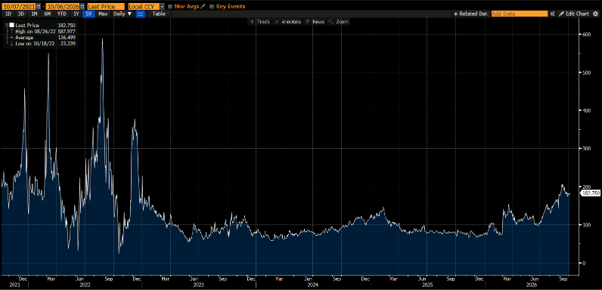
In July the market was pricing a ceasefire and a mild autumn. So far it has got neither. Brent has gone from around $72 at the start of July to roughly $100, and physical cargoes were changing hands above $110 at the end of September.
The diplomacy, meanwhile, has taken on the rhythm of a long-running soap opera, with a deal declared imminent roughly once a fortnight and a tanker shot at in between. In September the US destroyed five tankers linked to Iran’s Revolutionary Guards, and the Houthis started firing at Aramco facilities in southern Saudi Arabia for good measure. Tehran still wants the US naval blockade lifted and is angling for a toll booth on the side; Washington has no interest in either. We struggle to see a resolution from here.
In fairness to the optimists, crude is moving again. Gulf exports are back near pre-war levels, Riyadh is discounting to Asia, and the G7 has raided the emergency stockpiles, which is why Brent has come off its late-September highs. But the barrel was never really the problem. Refined products are still flowing at less than 60% of pre-war volumes, and US heating oil futures are up roughly 95% on a year ago and the shipping costs are through the roof; we know this as we own shares in the major firms. It’s an ill wind and all that.
UK Gas Prices Are Soaring and It’s Not Even Winter, Yet They Are Off Previous Highs Despite a More Dire Situation
Source: Bloomberg, October 13, 2026.
For anyone paying their bills in sterling, gas is what matters, and here the picture is grim. Europe goes into winter with storage around 72% full, against a five-year norm in the high 80s, and Dutch wholesale gas costs more than twice what it did a year ago. The Bank of England now expects inflation to reach around 3¾% this quarter and a little over 4% early next year. As we said in July, the thermostat was never going to be accommodating.
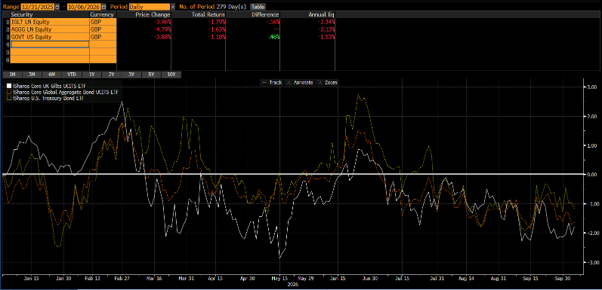
More importantly, this makes Gilts almost pointless, even more so when you factor in tax. At best, they are standing still; worse, they are one small FX move away from more losses.
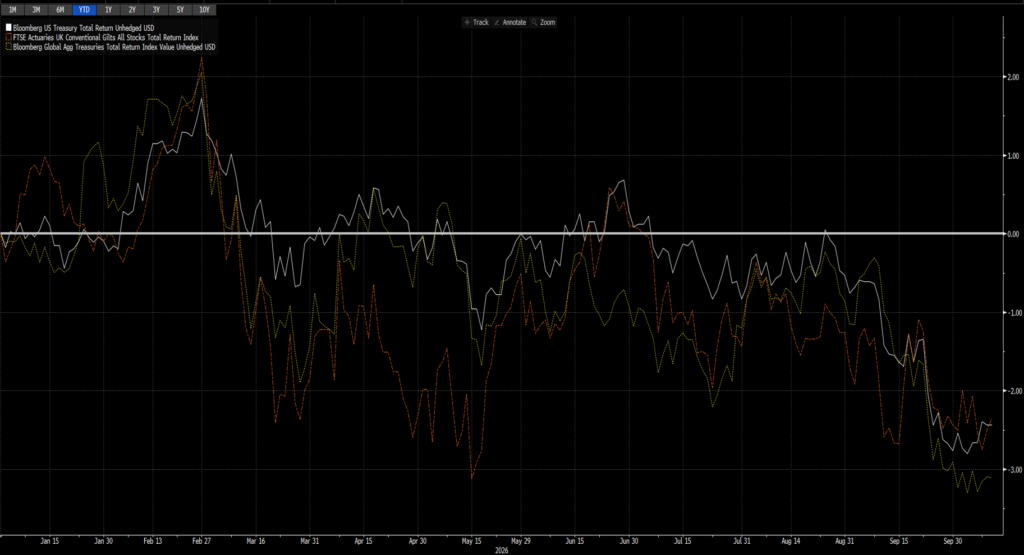
Gilts Are Having Another Bad Year
Source: Bloomberg, October 13, 2026.
Two Tribes (Frankie Goes to Hollywood, 1984)
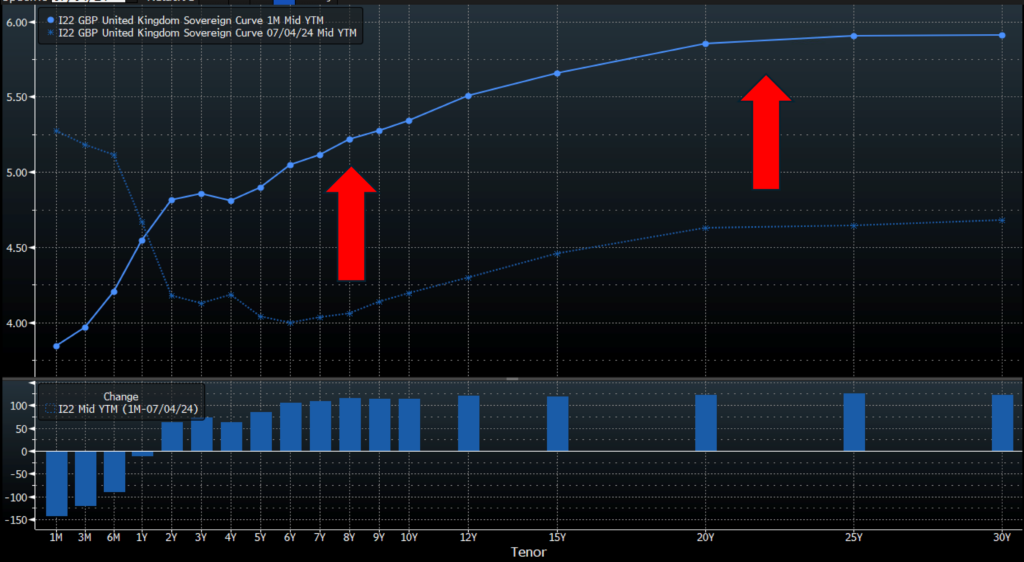
It has been a grim few months to own government bonds almost anywhere. The 30-year gilt went through 6% on 1 October for the first time since 1998, comfortably beyond anything seen during the Truss episode. The US 10-year has added more than 70 basis points since July to around 5.3%, its highest since 2002, and French 10-year yields briefly touched 5%. You could file the lot under “global bond rout” and move on, but that would miss what is actually going on, because the American and European problems are very different animals.
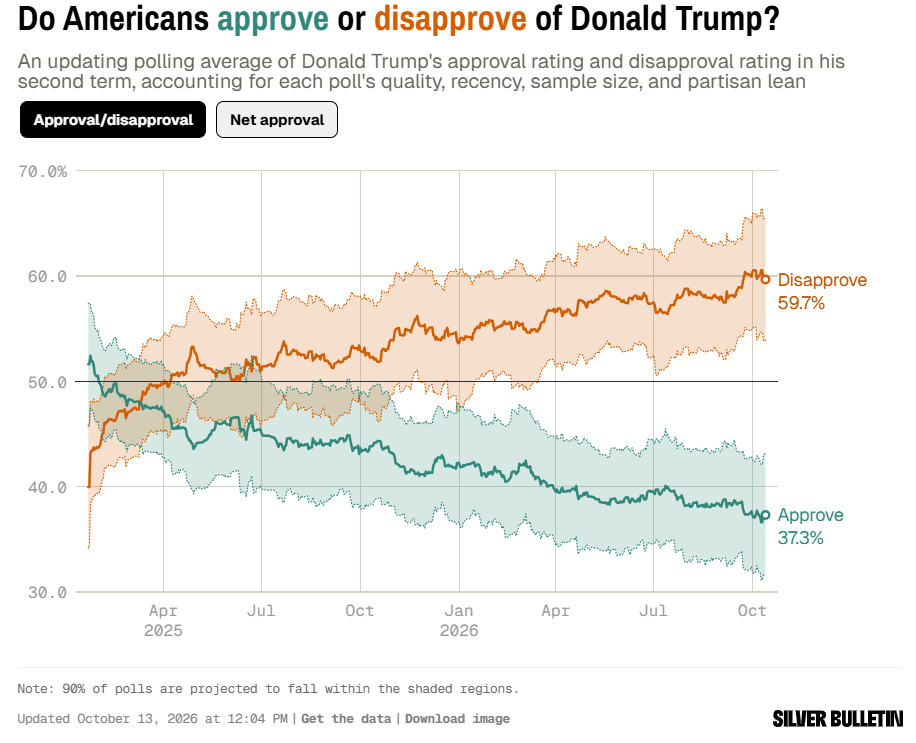
America’s problem is that the economy is running too hot. September’s payrolls were soft, at 29,000, and that is the number everyone quoted, but look across the quarter and the picture is rather different. The Atlanta Fed has third-quarter growth running near 3.7%, consumer prices are up 3.4% on the year, producer prices are up 5.4%, and the Fed, having cut three times last year, has started raising rates again. The one thing not running hot is pay, and that is precisely the problem: prices have outrun wages since the spring, and voters have noticed.
Only 17% of Americans approve of President Trump’s handling of the cost of living, according to AP-NORC, Democrats lead the generic ballot by double digits, and the midterms are four weeks away. Inflation is the one tax everybody pays, and they know exactly where to send the bill.
US Approval Rating
Source: Silver Bulletin, https://www.natesilver.net/p/trump-approval-ratings-nate-silver-bulletin, October 13, 2026.
Britain and Europe are a different story, closer to a stagnant mess than a boom, and here yields are rising because investors doubt the arithmetic rather than because anything is overheating. Britain has at least been rescued at the margin by what looks very much like the AI boom. Computer programming grew 3.5% in July alone, accounting for nearly a third of that month’s growth, and the ONS notes that many of the firms reporting the biggest turnover are in AI and cloud computing. That a corner of the tech sector now stands between Britain and stagnation is not much of a triumph, and rather a damning verdict on everything else, where output per hour fell 0.8% in the second quarter. And yet it still flatters us next to the Continent. The euro area’s second-quarter growth owed a good deal to Ireland, home to the European tax affairs of a fair chunk of Silicon Valley, while France managed no growth at all. Even Europe’s growth, such as it is, turns out to be borrowed from American tech.
Add inflation of 3.1% in Britain and 3.8% in the euro area, most of it energy we import, and you have two central banks with nowhere to go. The Bank of England held at 3.75% in September with three members voting to hike into an economy that can barely grow. France now pays more to borrow than Italy, its spread over Germany is the widest since the euro crisis, and the euro has slid to a 17-month low against the dollar.
US Bonds Are Having a Bad Year, Global Bonds Worse and Gilts Still Even Worse Still
Source: Bloomberg, October 13, 2026.
The difference matters for investors. America’s problem is cyclical, and will be cured eventually, either by the Fed or by the business cycle doing the Fed’s job for it. Europe’s needs a transfusion, and the only donor in town is the bond market, which couldn’t care less who lives in Downing Street or the Élysée so long as the sums add up. In September the Debt Management Office sold £4.25 billion of 30-year gilts at the highest yield since it was founded in 1998 and still drew more than £85 billion of orders. There is plenty of money out there; it just wants paying properly.
Ever Fallen in Love (With Someone You Shouldn’t’ve) (Buzzcocks, 1978)
In July we described a market that had dumped its old favourites. The Magnificent Seven were down for the year, small caps were having their best run since 1991, and the AI money had moved down the stack into a red-hot huddle of memory and chip stocks. We said at the time that rotation that violent tends to be a late-cycle tell.
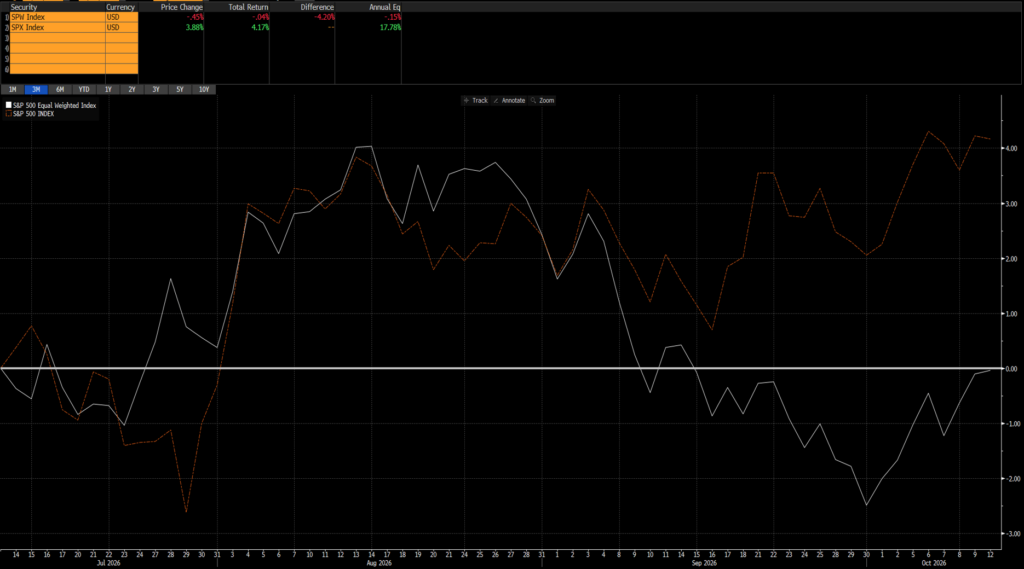
US S&P Equal Weight Is Underperforming the Broad Index Which Shows a Very Narrow Rally
Source: Bloomberg, October 13, 2026.
The third quarter promptly swung the whole thing back again. The S&P 500 rose about 2%, but the equal-weighted version of the same index fell 2%, small caps fell 7% and the chip stocks gave back 11%. The Magnificent Seven, written off barely three months ago, gained 11%. Just four of them (Microsoft, Nvidia, Apple and Meta) delivered more than twice the index’s entire gain, so the rest of the market, taken together, went backwards.
Underneath, it is uglier still. Only a quarter of S&P 500 stocks are trading above their 50-day moving average, and 60% are at least 20% below their all-time highs, so most of the index is in a bear market while the index itself flirts with a record. Even the safe places haven’t been safe: utilities, the old widows-and-orphans refuge, were the worst sector of the quarter, down 12% as yields rose. The giants, meanwhile, seem barely to have noticed the bond market at all.
Narrow markets can go on for longer than anyone expects, and we wouldn’t bet against the generals just because everyone owns them. But it is worth being clear about what you actually hold when you buy “the market”. Roughly 35 cents of every dollar invested in the S&P 500 goes to seven companies, which makes it less a diversified portfolio than a large bet on AI with 493 passengers along for the ride.
Money’s Too Tight (to Mention) (Simply Red, 1982)
As Helen said he would, Andy Burnham, the man the papers like to call the King of the North, walked into Downing Street in July without a contest, with John Healey as Chancellor. His first Budget is on 28 October.
It would be easy to pin the gilt market on the new tenant, and only half fair. The long end was under pressure well before he arrived, largely thanks to the previous inhabitants; Treasuries and French bonds have had just as rotten a quarter, and oil and inflation did as much damage in September as any speech. That said, promising a “new path” and a big expansion of public services at conference was never going to calm a market already asking 6% to lend for thirty years.
The Bond Market Has Been Selling Off Since the General Election
Source: Bloomberg, October 13, 2026.
For now, we are neutral on Burnham. We said in July that we hoped it would work out for him, and we meant it, but the Budget is where the rhetoric meets the arithmetic, and we would rather see the numbers before passing judgement. The bond market may not be so patient. By happy coincidence, the Fed also announces its decision on 28 October, so do keep the evening free or possibly a trip to Heathrow.
Helen has spent the summer a good deal closer to all this than we have and is far better placed to tell you who is actually running the show, so I’ll leave the gory details to her.
What does that mean? In short, the interval is over. The energy bill we flagged in July is turning up on time, the bond markets are sending invoices of their own (for different reasons either side of the Atlantic, but in the same direction), and the equity market is being held up by a handful of very large companies that have so far chosen to ignore all of it. We don’t think that calls for panic, but it is a good moment to know precisely what you own, and why.
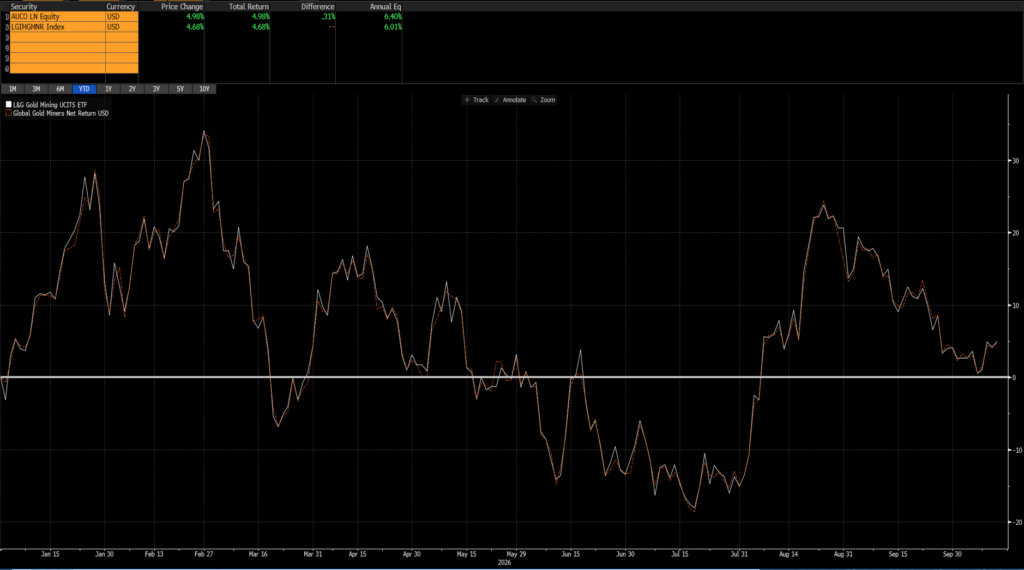
So what have we done? Our energy position has done very well, so much so that it has taken up a larger position in many portfolios through appreciation than we thought prudent, so we have pared it back. Regular readers will know we did the same with gold in early March, which has also proven prudent – so far. We fully expect to like Gold & Energy, but we are concerned with investor crowding as everybody thinks it’s a good idea.
Gold Has Had a Wild Ride Since Our Sale
Source: Bloomberg, October 13, 2026.
Counterintuitively, we have bought some corporate bonds in the recent volatility. We can get 8% yields for 5-year risk in names like Nationwide and Bupa, which we think is a good risk-return here to park your hard-earned capital.
More soon. And with that, over to Helen.
— Ben Ashby
Q4 2026 Outlook
There is a moment in every good political thriller when apparently disconnected plotlines suddenly converge. The clues have been accumulating for months: war in the Middle East, higher bond yields, swollen government borrowing, increasingly fragmented electorates and political leaders discovering that mandates won in calmer times offer little protection when circumstances change.
In the final quarter of 2026, many of those political risks will come home to roost.
Some events are already in the diary. Israel goes to the polls on 27 October, followed by the US midterms on 3 November. Both elections matter well beyond their own borders because their outcomes could influence the next phase of the conflict that has impaired the Strait of Hormuz and added another layer of uncertainty to the global economic outlook. A third election has now been added to the calendar, with Pedro Sánchez calling Spaniards to the polls on 29 November, eight months earlier than required.
Meanwhile France faces a high-stakes presidential election in six months and Britain has a new prime minister. Political risk need not trouble investors unduly when the economic environment is benign. But governments are being tested just as the bond market has become considerably less forgiving of political experimentation.
Bond. Government Bond.
The consequences of the Middle East conflict have added another inflationary impulse into an economy already adjusting to a world of much higher structural investment. At the same time, governments need ever more money for defence, welfare, infrastructure and the energy transition, while the private sector is embarking on its own borrowing spree to finance the data centres, power generation and other infrastructure required for artificial intelligence.
Everybody wants capital at once.
Recent corporate issuance offers a vivid indication of the competition. SoftBank raised $11bn in a record high-yield bond sale, only for the junk-rated portion of Paramount’s enormous financing for its Warner Bros acquisition to eclipse it shortly afterwards. Governments are therefore competing not just with one another but with companies for investors’ money, at precisely the moment that those investors are demanding greater compensation for inflation risk.
Higher yields matter everywhere, but they matter most for countries with large debts, weak growth and limited political willingness to confront either. The UK has been living with that vulnerability for some time. France has now joined it.
Liberté, Égalité, Fragilité
For the third year in succession, France enters the autumn with an embattled prime minister struggling to pass a Budget through a divided parliament. Until now, markets have largely treated each episode as another instalment of the same story: governments fall, budgets are delayed, emergency legislation keeps the state running and the political system somehow muddles through.
This time there is an important difference. France elects a new president in May 2027.
Marine Le Pen continues to command substantial support in first-round polling. Whatever eventually happens in that contest, investors can no longer simply assume that the institutional arrangements which have governed France for decades will remain unchanged.
Le Pen would, of course, reject the suggestion that markets should fear her taking office. Her economic programme includes substantial spending reductions, including a proposed €125bn over five years, alongside measures designed to force the deficit lower. Markets might ultimately approve of some of those proposals.
The risk lies elsewhere. A Le Pen presidency would test institutions, conventions and assumptions that have underpinned European politics for decades. The range of possible policy outcomes would widen sharply, and that matters far more in a world where investors have rediscovered the habit of charging governments for risk.
Whatever It Takes – With Terms and Conditions
The obvious defence against renewed sovereign stress in Europe is the European Central Bank. Ever since Mario Draghi promised to do “whatever it takes” to preserve the euro, investors have assumed that there is ultimately an institution in Frankfurt capable of preventing sovereign spreads from spiralling completely out of control.
The ECB sought to reinforce that assumption in 2022 when it created the Transmission Protection Instrument. Yet the small print matters. The TPI is intended to counter “unwarranted, disorderly market dynamics” that threaten the transmission of monetary policy, and eligibility includes compliance with the European fiscal framework, a sustainable public debt trajectory and the absence of severe macroeconomic imbalances.
Those conditions become awkward if the market is selling a country’s bonds for perfectly rational reasons.
France is already subject to the EU’s Excessive Deficit Procedure. If investors demand a greater risk premium because they doubt the willingness or ability of French politicians to stabilise the public finances, it becomes much harder to argue that wider spreads are simply an unwarranted malfunction of monetary transmission. And if politicians were to think the ECB will suppress borrowing costs whenever fiscal choices provoke market stress, there is less incentive for them to take the difficult decisions required to restore credibility. Monetary protection risks turning into fiscal insurance, which would ultimately weaken rather than strengthen the European project.
The institution itself is also approaching a period of transition, with both the President and Chief Economist ending their terms in office next year. The new appointees will arrive just as the ECB could be confronting some of the most politically difficult questions of its existence.
France has already provided a useful reminder that technocratic institutions do not operate in a political vacuum. The new Governor of the Banque de France, Emmanuel Moulin, was previously Secretary-General of the Elysée under Macron, before that chief of staff to Prime Minister Gabriel Attal, and before that Director-General of the Treasury.
Central banks may be operationally independent. That does not make the environment in which they operate politically neutral.
Kanzlertausch
Nor is France the only potential source of instability at the core of Europe.
Germany has no scheduled federal election, but pressure is building around Chancellor Friedrich Merz. A “Kanzlertausch”, replacing the Chancellor without first holding a general election, is unusual but hardly unknown. It happened four times between 1963 and 1982. Those precedents may belong to another political age, but they are beginning to look rather more relevant.
Merz’s approval rating had fallen to just 11% at the beginning of October, while discussion has already begun around potential successors. The regional election results hardly helped. The CDU failed even to reach the 5% threshold required for representation in Mecklenburg-Vorpommern, an extraordinary humiliation for the party of the sitting Chancellor. Meanwhile the AfD won around 44% in Saxony-Anhalt in September, finishing only three seats short of an outright majority. It is moving ever closer to institutional positions previously thought beyond its reach. The firewall maintained by Germany’s mainstream parties has not disappeared, but each electoral advance makes it harder to sustain indefinitely.
Germany therefore faces its own version of the problem confronting France: political structures created for an era of stable mainstream parties are being tested by much more fragmented electorates. And although Germany begins from a stronger fiscal position, both countries are preparing to borrow record amounts in the year ahead.
Together, they are changing both the supply and the political characteristics of the sovereign assets sitting at the centre of European Monetary Union.
Sánchez the Survivor
Spain has lobbed its own hand grenade into the mix.
Pedro Sánchez’s decision to call an election on 29 November followed the defeat in parliament of two emergency housing decrees introduced after national outrage over the eviction of an 87-year-old woman. The measures were intended to protect vulnerable tenants from eviction, constrain rent rises and strengthen renters’ rights.
Parliament voted them down, handing Sánchez an opportunity.
Housing has become one of the defining political issues in Spain. Protesters on the streets of Madrid may be furious about a crisis that has worsened during Sánchez’s own period in office, but on this particular battle he can plausibly argue that they and his government are on the same side: ministers tried to introduce greater protections and opposition parties stopped them.
Sánchez is now attempting to turn that distinction into the organising question of the election. It is a considerable gamble given that his Socialist Party enters the campaign from a difficult position, but then Sánchez has made a political career out of such gambles.
He first became prime minister in 2018 after winning a constructive vote of no confidence against the incumbent despite his party holding just 84 of the 350 seats in Congress. Since then he has survived internal party revolt, electoral setbacks, minority government, Catalan separatist demands and repeated predictions of his political demise.
His instinct is remarkably consistent: when trapped, change the terms of the contest.
There is another European prime minister who may recognise the tactic.
The Burnham Ultimatum
On 28 October, Chancellor John Healey will deliver his first Budget. It has been presented as an exercise in reassurance rather than revolution: make the numbers add up, demonstrate fiscal credibility and avoid alarming a gilt market already contending with higher inflation and higher global yields.
Some tax rises will be needed to fill the £5bn hole left by Starmer’s Defence Investment Plan and to restore some of the fiscal headroom lost to higher gilt yields. Taxes on gambling and banks look set to be joined by tweaks such as lowering the threshold at which the new “mansion tax” applies.
But this Budget is merely a springboard to the main event.
Its constraints are both a threat and an opportunity for Andy Burnham. That was the message hidden in plain sight in his party conference speech, where he began to set out his own priorities. His premiership was created under somebody else’s manifesto, somebody else’s fiscal framework and somebody else’s political mandate. Labour’s parliamentary majority may technically be his to command, but the policies Burnham increasingly wants to pursue are not those on which those MPs were elected.
Andy Burnham needs an election.
From Ultimatum to Mandate
His conference speech laid out the beginnings of an alternative programme: a National Care Service, reform of the triple lock, a different approach to public ownership, greater devolution, voting reform and a re-examination of Britain’s relationship with Europe.
These are not minor adjustments to somebody else’s manifesto. They require a mandate of their own.
Labour’s enormous parliamentary majority is less useful to Burnham than it appears. Governments have already discovered that a large majority does not automatically confer public consent for whatever follows. The furore over the removal of the Winter Fuel Payment and the inability to enact welfare reforms show that Labour might have the numbers but it does not have a mandate.
Burnham faces the same problem on a much larger scale. Every month he remains in office without an election, more decisions must be taken within the constraints of the Starmer-Reeves settlement and more questions will be asked about his legitimacy to overturn it. He was not even an MP at the 2024 general election. His incentive is therefore not to preserve Labour’s inherited majority for as long as possible, but to exchange it for one of his own.
That remains true even if the eventual majority is smaller. A parliament requiring cooperation with a broadly sympathetic party such as the Liberal Democrats might still give Burnham more genuine political authority than hundreds of restive Labour MPs elected to deliver somebody else’s programme.
The October Budget actually helps that strategy because it can demonstrate the constraint. It can show what the existing fiscal framework permits, which taxes are required to make the numbers add up and which spending promises cannot be delivered within it. Burnham can then ask the electorate for permission to do something different.
The Burnham Supremacy
Calling an early election would be a gamble, but Burnham has form in waiting for the moment when a gamble becomes worth taking. He became Labour leader at the third attempt and, like Sánchez, his political career is a lesson in survival, patience and recognising when circumstances have finally turned in his favour.
The circumstances are turning now.
Labour has enjoyed a post-conference bounce, with recent YouGov voting intention putting it on 27%, ahead of Reform on 22% and the Conservatives on 20%, while the Liberal Democrats and Greens are both on 11%.
Those numbers are historically low for a governing party, but in a fragmented first-past-the-post system the relative figures matter more than the absolute ones. The last general election delivered a landslide majority to a party on just 34% of the vote, and since then the electorate has fragmented further. There is no reason to assume the next government will require anything close to a traditional winning vote share.
That creates an opportunity for Burnham. His political strategy is increasingly capable of consolidating voters to his Left while his opponents on the Right continue to divide them.
His offer of electoral reform and a rethink of Britain’s relationship with Europe reduces the distance between Labour and the Liberal Democrats. The Greens are preoccupied with internal disputes and their leader Zack Polanski is the only major party leader not yet in Parliament. On the other side, Reform’s earlier momentum has been interrupted by scandal and the messy assimilation of defecting Conservatives, while the Tory brand remains badly damaged after its worst general election result in modern history, even as Kemi Badenoch’s own ratings have improved.
Burnham’s conference speech suggested he understands the opening.
Most politicians would regard the triple lock as close to untouchable. Burnham chose to question it and linked reform directly to the creation of a National Care Service. That was not the behaviour of a prime minister preparing to administer the remainder of somebody else’s term. It looked much more like the opening argument of an election campaign.
The earliest practical window after the Budget could be December, although the more obvious staging point is 6 May 2027, when Britain is already due to hold local elections. Whether the election ultimately falls in Q4 or Q1 matters less than the fact that, during this quarter, the prospect of one is likely to become increasingly difficult for markets to ignore.
My expectation remains that Burnham will call one.
The Fourth-Quarter Reckoning
That leaves investors facing an unusually combustible final quarter. The consequences of the Middle East conflict are already feeding through into inflation and bond markets; Israel and the United States go to the polls with the future course of that conflict in the balance; Spain has unexpectedly joined the electoral calendar; France is heading towards a presidential election capable of overturning assumptions embedded in European markets for decades; and Germany’s governing party has suffered extraordinary regional defeats while questions grow around the future of its Chancellor. In the UK the Budget on 28 October is unlikely to close the political argument, instead providing the springboard to the next election campaign.
The usual suppressant for market volatility is also less readily available. Central banks cannot simply ride to the rescue with aggressive rate cuts when inflation remains uncomfortable, while governments are trying to borrow more and electorates are fragmenting around politicians increasingly willing to challenge the economic and institutional consensus of recent decades.
That is a recipe for a more volatile regime.
From Washington to Madrid, Paris and Berlin, the political plot is thickening just as bond markets are becoming less forgiving. In the UK, The Burnham Identity is moving into The Burnham Supremacy. There is plenty of scope for unexpected twists and action-packed drama in this latest instalment. Get ready to watch from the edge of your seats.
—Helen Thomas
Important Information
This document is issued by Henderson Rowe for information purposes only. It does not constitute a personal recommendation, investment advice or an offer to transact. Past performance is not a reliable indicator of future results and the value of investments can fall as well as rise; you may not get back the amount you invest. Any views expressed are subject to change and may become outdated. Investments may not be suitable for every investor and you should seek advice based on your individual circumstances.


